
SEO Tools
SEO Tools by PMO-Tech help website owners, marketers, bloggers, developers and businesses improve search visibility, technical SEO, on-page optimization, content quality and website performance using free browser-based tools.
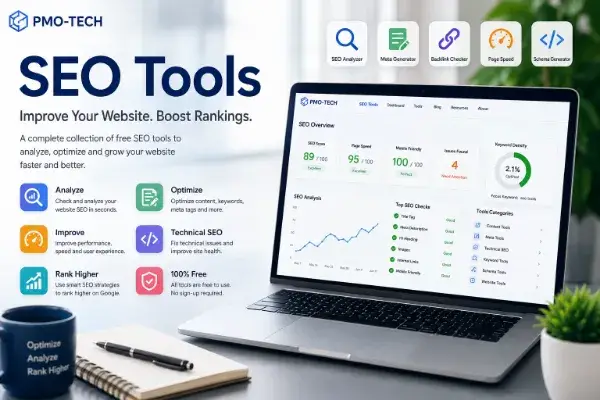
SEO Tools for Better Website Visibility
SEO Tools help website owners understand how their pages appear to search engines and users. A successful website needs more than attractive design. It also needs clear titles, useful content, proper headings, optimized descriptions, readable URLs, structured data, internal links, fast loading pages and content that answers real search intent.
PMO-Tech SEO Tools are designed to support daily search engine optimization tasks without requiring expensive subscriptions. These free browser-based tools can help you check keyword usage, generate meta descriptions, create SEO titles, format URLs, build schema markup, inspect headings, estimate reading time and improve content structure.
Whether you are building a service page, publishing a blog post or optimizing a landing page, these SEO Tools provide quick assistance during the content creation and review process. They are useful for small business owners, SEO beginners, content writers, digital marketers, developers and agencies that need practical utilities for improving website content.
Why Businesses Need Reliable SEO Tools
Search engine optimization is one of the most important long-term marketing channels for any website. Paid advertising can stop producing results as soon as the budget ends, but well-optimized content can continue attracting visitors over time. This is why businesses invest in SEO content, technical improvements, internal linking, structured data and website performance.
Many websites fail to rank because pages are published without checking basic SEO elements. A page may have a weak title, missing meta description, poor heading structure, thin content, duplicate keywords, no internal links or missing schema markup. These issues may seem small individually, but together they can reduce search performance.
PMO-Tech SEO Tools help identify and improve these common problems. Instead of guessing whether a title is too long, a meta description is too short or a keyword is overused, users can quickly review content and make practical improvements before publishing.
Improve On-Page SEO
Review titles, descriptions, headings, keyword usage, content length and internal links before publishing.
Support Technical SEO
Generate robots.txt files, schema markup, Open Graph tags, Twitter cards and cleaner URLs.
Create Better Content
Use word counters, reading time tools and keyword checkers to improve content quality and readability.
Save Time
Complete common SEO checks faster without switching between many different websites.
Improve Click-Through Rate
Create stronger titles and descriptions that encourage users to click from search results.
Free Browser-Based Tools
Use the tools instantly without signup, subscription or paid API access.
What You Can Do With PMO-Tech SEO Tools
The PMO-Tech SEO Tools collection is designed to cover the most common optimization tasks required during website development, content writing and publishing. Instead of relying on one large audit tool, this toolkit gives users focused utilities for specific jobs.
You can use the meta generator to create search snippets, the SEO title tool to prepare title tags, the keyword density checker to review keyword usage, the slug generator to create readable URLs and the schema tools to prepare structured data. Each tool solves a specific problem and supports better website optimization.
Meta Tools
Create SEO titles, meta descriptions, Open Graph tags and Twitter Card markup for better search and social previews.
Content Tools
Check word count, reading time, keyword density, headings and content quality before publishing pages or blog posts.
Schema Tools
Generate structured data for FAQs, articles, local businesses, organizations and breadcrumbs.
Technical Tools
Create robots.txt files, sitemaps, canonical tags, clean URLs and optimized code snippets.
Optimization Tools
Minify HTML, CSS and JavaScript to reduce file size and improve loading performance.
Research Tools
Extract keywords, review page structure and prepare content plans for SEO-focused pages.
How SEO Tools Improve On-Page Optimization
On-page optimization focuses on improving the visible and structural elements of a page. This includes the H1 heading, subheadings, body content, keyword usage, internal links, image alt text, page title and meta description. Search engines use these signals to understand what a page is about and whether it is useful for a search query.
A strong page should begin with a clear focus keyword, but it should not repeat that keyword unnaturally. Keyword density tools can help identify whether a phrase is missing, underused or overused. This is especially useful when using SEO plugins that measure keyword usage and content quality.
Heading structure is also important. A page should normally have one clear H1 and several useful H2 or H3 headings that organize the content. A heading checker can help identify missing headings, repeated headings or poor structure. This improves both search engine understanding and user experience.
Meta descriptions do not directly guarantee rankings, but they can influence click-through rate from search results. A clear description helps users understand what the page offers before they click. PMO-Tech SEO Tools help create descriptions that are concise, readable and benefit-focused.
Technical SEO Tools for Cleaner Website Structure
Technical SEO ensures that search engines can crawl, understand and display website pages correctly. Common technical tasks include creating robots.txt rules, generating sitemaps, adding canonical tags, using structured data, optimizing code and improving how pages appear on social platforms.
A robots.txt generator can help website owners control which parts of a site should be accessible to search engine crawlers. A sitemap tool helps organize important URLs so search engines can discover them efficiently. Canonical tags help prevent duplicate content issues by telling search engines which version of a page should be treated as the primary version.
Structured data is another valuable technical SEO element. Schema markup can help search engines understand page type, business details, FAQs, articles and breadcrumb navigation. While schema does not guarantee rich results, it improves machine-readable context and supports better search understanding.
PMO-Tech SEO Tools include utilities that support these technical tasks. These tools are especially useful for WordPress users, developers and website owners who want practical helpers without installing too many separate plugins.
SEO Tools for Content Writers and Bloggers
Content quality is one of the strongest foundations of search performance. Search engines aim to show pages that are useful, clear and relevant to the user’s query. Thin content, duplicated paragraphs, poor structure and unclear intent can reduce a page’s ability to rank.
Writers can use SEO Tools during the drafting process to check whether content is long enough, whether keywords are distributed naturally and whether subheadings cover the topic properly. A word counter and reading time calculator can help estimate whether a page is detailed enough for its purpose.
Keyword extractors can help identify repeated words and phrases inside a draft. This is useful when reviewing whether the page has strong topical relevance. If the main topic does not appear often enough, the content may need more focused explanation. If the same phrase appears too many times, the writing may need more natural variations.
Bloggers can also use title generators, meta description tools and slug generators to prepare each article before publishing. These small improvements can make content easier to understand, easier to share and easier to optimize.
Creating Better SEO Titles and Meta Descriptions
Search snippets are often the first impression a user has of your website. The title tells users what the page is about, while the meta description explains why they should click. Poor snippets can reduce traffic even if the page ranks well.
A strong SEO title should include the main topic, communicate value and remain readable. It should not be stuffed with keywords or written only for search engines. The best titles are clear for both users and algorithms.
Meta descriptions should summarize the page in a persuasive way. They should highlight benefits, explain what the user can expect and include a natural call to action when appropriate. PMO-Tech SEO Tools help generate and check these elements so users can improve pages before publishing.
How Internal Links Improve SEO and User Experience
Internal links connect related pages across your website. They help visitors discover more content and help search engines understand relationships between topics. A service page can link to supporting blog posts, tools, case studies and contact pages. A blog post can link back to service pages and related resources.
PMO-Tech uses internal links to connect useful services such as Search Engine Optimization, Website Optimization, Digital Marketing, Custom Web Development and CRM Development.
Internal linking should be natural. Do not add links only for SEO scores. Add links where they help users continue learning, solve related problems or move toward a useful next step.
Useful External SEO Resources
SEO changes over time, so it is useful to follow trusted search and marketing resources. The following external links provide helpful information for website owners, developers and marketers who want to improve search performance.
Google Search Central
Official documentation and SEO guidance from Google for website owners and developers.
Bing Webmaster Tools
Resources for improving visibility in Microsoft Bing search results.
Schema.org
Reference vocabulary for structured data used by search engines and web applications.
PageSpeed Insights
Google tool for reviewing page loading performance and Core Web Vitals recommendations.
All SEO Tools
Select any SEO Tool below to improve titles, descriptions, schema, keyword usage, headings, technical SEO and content quality for your website.
SEO Tools
Use this category shortcode to show only the SEO tools on one dedicated page.
SEO Title Generator
Create SEO title ideas and length checks.
Result
Your result will appear here.
Keyword Density Checker
Check keyword density in text.
Result
Your result will appear here.
URL Slug Generator
Convert titles into SEO-friendly URL slugs.
Result
Your result will appear here.
Word & Character Counter
Count words, characters and reading time.
Result
Your result will appear here.
FAQ Schema Generator
Create basic FAQ JSON-LD schema.
Result
Your result will appear here.
Meta Title Length Checker
Check SEO title length.
Result
Your result will appear here.
Meta Description Length Checker
Check meta description length.
Result
Your result will appear here.
Keyword Extractor
Extract repeated keywords from content.
Result
Your result will appear here.
Heading Structure Checker
Check H1-H6 structure from HTML.
Result
Your result will appear here.
Robots.txt Generator
Generate robots.txt rules.
Result
Your result will appear here.
Sitemap URL List Generator
Create XML sitemap from URL list.
Result
Your result will appear here.
Canonical Tag Generator
Generate canonical link tag.
Result
Your result will appear here.
Open Graph Generator
Generate Open Graph meta tags.
Result
Your result will appear here.
Twitter Card Generator
Generate Twitter/X card meta tags.
Result
Your result will appear here.
JSON-LD Schema Generator
Generate Organization, Article or Local Business schema.
Result
Your result will appear here.
Breadcrumb Schema Generator
Generate breadcrumb JSON-LD.
Result
Your result will appear here.
Organization Schema Generator
Generate organization JSON-LD.
Result
Your result will appear here.
Article Schema Generator
Generate article JSON-LD.
Result
Your result will appear here.
Local Business Schema Generator
Generate local business JSON-LD.
Result
Your result will appear here.
Reading Time Calculator
Calculate reading time from content.
Result
Your result will appear here.
Website SEO Tools for Every Business
Website SEO Tools help businesses improve website visibility, user experience and search engine performance. Whether you manage a small business website, an ecommerce store or a corporate platform, using the right Website SEO Tools makes it easier to optimise titles, headings, images, structured data and internal links. Instead of completing every optimisation task manually, website owners can use practical utilities that simplify common SEO activities while maintaining content quality.
PMO-Tech has developed a collection of Free SEO Tools that can be used directly in your browser without subscriptions or paid APIs. These Free SEO Tools are designed for business owners, bloggers, developers, digital marketers and agencies that want reliable optimisation utilities without additional software costs. Every tool has been created to solve a specific SEO task while remaining simple enough for beginners and useful enough for experienced professionals.
Search Engine Optimization Tools That Save Time
Modern Search Engine Optimization Tools help users analyse content, improve technical SEO and prepare better website pages. Instead of guessing whether a title is too long or a page needs additional headings, Search Engine Optimization Tools provide quick feedback that supports better decision making before content is published.
Using multiple optimisation utilities together creates a stronger workflow. A writer can prepare an SEO title, generate a meta description, review keyword placement, check heading structure and improve readability before publishing. This systematic approach helps produce better quality pages while reducing the likelihood of common optimisation mistakes.
Why Choose PMO-Tech?
Unlike many online utilities that only provide one function, PMO-Tech combines Website SEO Tools, Free SEO Tools and Search Engine Optimization Tools into one professional platform. This allows users to complete content optimisation, technical reviews and metadata creation without moving between multiple websites.
As your website grows, these optimisation utilities become valuable resources for maintaining consistency across service pages, blog articles and landing pages. Whether you are improving one page or managing an entire website, using structured optimisation processes helps create stronger long-term search performance.
SEO Tools FAQs
Are PMO-Tech SEO Tools free?
Yes. These SEO Tools are free to use and designed to work directly in your browser.
Can SEO Tools improve rankings?
They help improve page quality, structure and optimization, but rankings also depend on competition, content quality, backlinks and technical performance.
Do I still need manual SEO review?
Yes. Tools support the process, but human review is important for accuracy, search intent and content quality.
Can I use these tools for WordPress pages?
Yes. They are useful for WordPress pages, blog posts, landing pages and service pages.
What is the most important SEO tool?
It depends on the task. For content pages, title, meta description, keyword density, heading and word count tools are especially useful.
Do these tools require an API?
No. PMO-Tech SEO Tools are designed to work without paid APIs or external AI costs.