
Tender Documentation
Tender Documentation Services
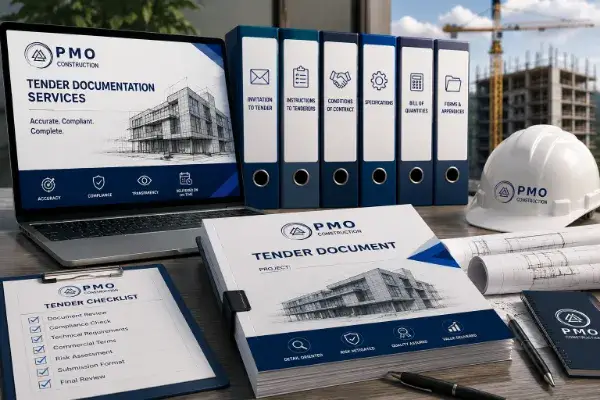
PMO Construction prepares professional Tender Documentation for construction procurement, including Tender Documents, Tender Specifications, Construction Tender packages and Contract Documentation for owners, consultants and contractors.
Executive Procurement Dashboard
Tender ReadyClear Procurement Information Before Construction Begins
Successful construction projects begin before work starts on site. They begin with clear procurement information, coordinated drawings, accurate quantities, realistic technical requirements and contract conditions that every bidder can understand. When the information issued to contractors is incomplete or inconsistent, the result is usually unclear pricing, excessive clarifications, later variations and avoidable disagreement after award.
PMO Construction prepares procurement packages that help clients move from design information to contractor pricing with confidence. Our process connects engineering drawings, Bills of Quantities, technical requirements, scope descriptions and commercial terms into one coordinated package. This improves transparency for the client and gives contractors the information they need to prepare realistic submissions.
The purpose is not only to produce paperwork. The purpose is to reduce uncertainty. When bidders receive clear Tender Documents, consistent Tender Specifications, a complete Construction Tender package and practical Contract Documentation, the client can compare submissions more fairly and select a contractor based on value, capability and compliance rather than guesswork.
Good Tender Preparation Reduces Cost, Delay and Disputes
Better Pricing
Clear quantities, drawings and specifications help contractors price the same scope instead of making different assumptions.
Better Comparison
Structured bid documents make it easier to compare contractor submissions on a like-for-like basis.
Lower Risk
Coordinated procurement information reduces scope gaps, unclear responsibilities and future variation claims.
Stronger Delivery
A well-prepared package becomes the foundation for administration, supervision and successful project completion.
Complete Procurement Services for Tender Packages
A complete procurement package should explain the project clearly enough for qualified contractors to understand the work, price it accurately and submit a compliant proposal. PMO Construction supports this process by preparing coordinated documents that connect technical requirements, commercial structure, drawings and contract expectations.
Tender Documents
Organised bid documents including scope, instructions, drawings, BOQ, technical requirements and submission rules.
Tender Specifications
Clear material, workmanship, testing, installation and quality requirements for construction pricing.
Construction Tender
Complete tender packages prepared for contractor pricing, evaluation and procurement decision-making.
Contract Documentation
Commercial and contractual documents that define responsibilities, obligations, payment procedures and project requirements.
Our Tender Package Workflow
Project Review
Review drawings, scope, project goals and procurement requirements.
BOQ
Prepare quantities and pricing structure for commercial clarity.
Specifications
Define technical standards, materials, workmanship and quality expectations.
Tender Issue
Compile coordinated documents for contractor pricing and evaluation.
What Every Tender Package Should Include
Tender Documents should provide a complete and organised description of the work being procured. A contractor should be able to understand the scope, pricing format, submission requirements, technical expectations, design references and commercial obligations without relying on assumptions.
PMO Construction prepares bid documents that normally include the invitation to tender, instructions to bidders, form of tender, scope of work, drawings, Bill of Quantities, technical specifications, contract conditions and supporting information. Each component must be coordinated so bidders receive one clear message rather than conflicting instructions.
- Instructions to bidders: submission rules, deadlines, formats and required attachments.
- Scope of work: clear description of what is included and what is excluded.
- Commercial documents: BOQ, pricing schedules and payment-related requirements.
- Technical documents: drawings, specifications and quality expectations.
BOQ Preparation for Transparent Contractor Pricing
The Bill of Quantities provides the commercial structure of a tender package. It lists measurable work items so contractors can price the same scope in a consistent format. Without a properly prepared BOQ, each bidder may price the project differently, making comparison difficult and increasing the risk of missed items.
PMO Construction prepares BOQs by reviewing drawings, specifications and project scope together. Quantities are organised into logical work sections so clients can compare contractor rates, evaluate pricing gaps and manage future variations more effectively. A structured BOQ also supports interim valuations, progress payments and final account review after the contract is awarded.
Technical Requirements That Define Construction Quality
Tender Specifications explain the required quality of materials, workmanship, testing, installation, inspection and performance. They are essential because drawings show what is to be built, while specifications explain how the work should be executed and what standards must be achieved.
PMO Construction prepares specification content that aligns with drawings, BOQ descriptions and project expectations. Clear specifications reduce pricing uncertainty and help contractors understand the quality level required before submitting their offer. They also support construction supervision because the same requirements can be used later for inspections, testing and approval processes.
Coordinated Tender Drawings Minimise Procurement Risk
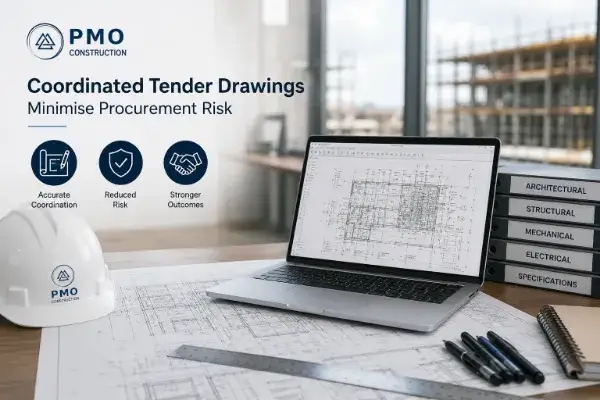
Tender Drawings communicate the physical design of the project and are one of the most important components of every Construction Tender package. Architectural, structural, civil and MEP drawings must work together so contractors can clearly understand what is to be built. Missing details, conflicting dimensions or poorly coordinated drawings frequently result in requests for clarification, inconsistent pricing and unnecessary commercial risk.
PMO Construction reviews Tender Drawings before issue to ensure they correspond with the Bill of Quantities, Tender Specifications and Scope of Work. This coordination process reduces ambiguity while improving procurement efficiency. Contractors receive a clearer understanding of the project, consultants spend less time responding to queries and owners obtain more reliable tender submissions.
Coordinated drawings continue to provide value after procurement because they become part of the contract documentation used during construction supervision, quality inspections and project administration.
A Well Defined Scope Creates Better Contractor Pricing
Every successful procurement process begins with a clearly defined Scope of Work. Contractors should understand exactly what work is included, what standards are expected and what responsibilities they are assuming before submitting their prices. Ambiguous scope descriptions often produce inconsistent bids because each contractor interprets the project differently.
PMO Construction prepares detailed scope documentation describing construction activities, engineering responsibilities, temporary works, testing requirements, commissioning obligations and final deliverables. Clear scope definition improves pricing accuracy while reducing misunderstandings after contract award.
- Included Works — Construction activities covered within the contract.
- Excluded Works — Responsibilities outside the contractor’s scope.
- Project Deliverables — Documentation, testing and handover requirements.
- Quality Requirements — Standards expected throughout construction.
Employer Requirements Define Project Expectations
Employer Requirements describe the client’s operational objectives, functional expectations and overall project vision. While drawings explain physical construction, Employer Requirements communicate performance expectations, operational standards, maintenance considerations and project objectives that contractors must satisfy.
PMO Construction develops Employer Requirement documents that integrate with Tender Specifications, Contract Documentation and procurement strategy. Providing this additional guidance enables bidders to understand the project beyond the drawings while producing more consistent and technically compliant submissions.
Procurement Readiness Scorecard
Before issuing procurement documents, every package should be reviewed for completeness, technical coordination and commercial consistency to minimise procurement risk.
- ✓ Drawings Coordinated
- ✓ BOQ Verified
- ✓ Specifications Completed
- ✓ Contract Conditions Reviewed
- ✓ Scope Confirmed
- ✓ Submission Requirements Finalised
Selecting Contractors Beyond The Lowest Price
Contractor selection should evaluate more than price alone. Technical capability, financial stability, construction experience, available resources, programme methodology, quality systems and health and safety performance all influence successful project delivery. Selecting the lowest bidder without considering these factors can introduce significant delivery risks.
Procurement Risk Matrix
Choosing The Right Procurement Strategy
Procurement strategy has a direct influence on project cost, programme, contractual risk and overall construction performance. Every project should adopt a procurement approach appropriate for its complexity, market conditions and client objectives. Traditional procurement, Design & Build, EPC and Construction Management each offer different advantages depending on project requirements.
PMO Construction helps clients evaluate procurement options before documentation is issued. Selecting the right procurement strategy improves market competition, strengthens contractor engagement and contributes to more predictable project delivery.
Digital Tender Documentation Improves Collaboration And Accuracy
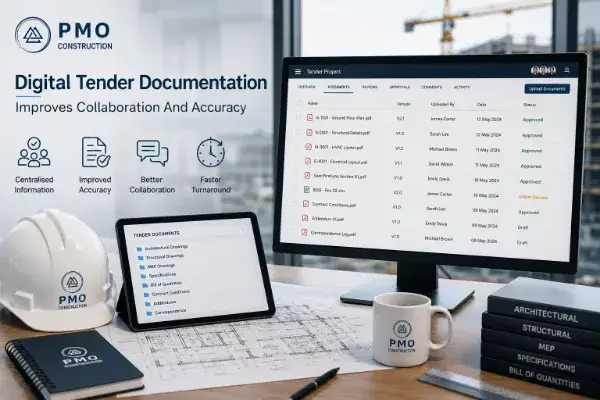
Modern construction procurement has evolved beyond printed drawings and paper-based submissions. Today’s projects rely on digital document management, cloud collaboration, BIM coordination and electronic tender platforms that enable project teams to access current information from virtually anywhere. Digital procurement improves communication while reducing administration time and document duplication.
PMO Construction prepares procurement documentation using structured digital workflows that improve revision control, document traceability and coordination between architects, engineers, quantity surveyors and project managers. Every revision is managed carefully so contractors receive the latest approved information throughout the tender period.
Digital documentation also supports construction management after contract award. Drawings, specifications, BOQs and commercial information remain organised within a controlled environment, making project administration significantly more efficient throughout construction.
Common Tender Documentation Mistakes To Avoid
Incomplete Drawings
Missing details force contractors to make assumptions, resulting in inconsistent pricing and additional clarification requests.
Conflicting Documents
BOQs, specifications and drawings should always agree with one another before procurement begins.
Poor Scope Definition
An unclear scope frequently results in variations, claims and disputes after contract award.
Insufficient Review
Independent technical reviews before tender issue help identify errors before they become construction problems.
Procurement Documentation Across Multiple Construction Sectors
Commercial Buildings
Office developments, shopping centres and mixed-use commercial projects.
Residential Projects
Villas, apartments, gated communities and residential developments.
Industrial Facilities
Factories, warehouses, logistics centres and manufacturing plants.
Healthcare & Institutional
Hospitals, educational facilities, laboratories and public sector projects.
International Standards And Industry References
PMO Construction follows internationally recognised construction management principles and procurement best practices. The following organisations provide valuable guidance covering project management, planning, procurement, BIM, estimating and engineering standards.
-
Project Management Institute (PMI)
https://www.pmi.org/ -
FIDIC
https://fidic.org/ -
Oracle Primavera P6
https://www.oracle.com/construction-engineering/primavera-p6/ -
AACE International
https://web.aacei.org/ -
buildingSMART International
https://www.buildingsmart.org/
Tender Documentation FAQs
What is Tender Documentation?
It is the complete procurement package used to obtain competitive construction bids.
Why are Tender Documents important?
They improve pricing accuracy, reduce disputes and create fair contractor competition.
Do Tender Documents include BOQs?
Yes. Bills of Quantities form one of the most important commercial documents within a procurement package.
Can PMO Construction review existing procurement documents?
Yes. We review drawings, specifications, BOQs and procurement documentation before tender issue.
Can you prepare Contract Documentation?
Yes. We assist with contract conditions, procurement documents and commercial requirements.
Do you prepare Tender Specifications?
Yes. Technical specifications are developed alongside drawings and BOQs to ensure consistency.
Can you coordinate architectural and MEP drawings?
Yes. Drawing coordination is an important part of reducing procurement risk.
Do you provide procurement advice?
Yes. We help clients select procurement strategies and evaluate contractor submissions.
Can services be provided remotely?
Yes. Most documentation and review services can be completed remotely.
Which sectors do you support?
Commercial, residential, healthcare, industrial and infrastructure projects.
Can you prepare procurement documentation for consultants?
Yes. We support architects, engineers, consultants, developers and project owners.
Why choose PMO Construction?
We combine engineering knowledge with professional project management practices to produce coordinated procurement documentation.
Professional Tender Documentation For Successful Construction Procurement
Whether you require complete Tender Documentation, Tender Specifications, Bills of Quantities, procurement planning or Contract Documentation, PMO Construction delivers coordinated engineering documentation that supports transparent procurement and successful construction delivery.